
Makeup Not Sitting Right? Let’s Talk Dermaplaning
Before you buy another foundation, let’s talk about surface texture, peach fuzz, and what your skin might actually need.
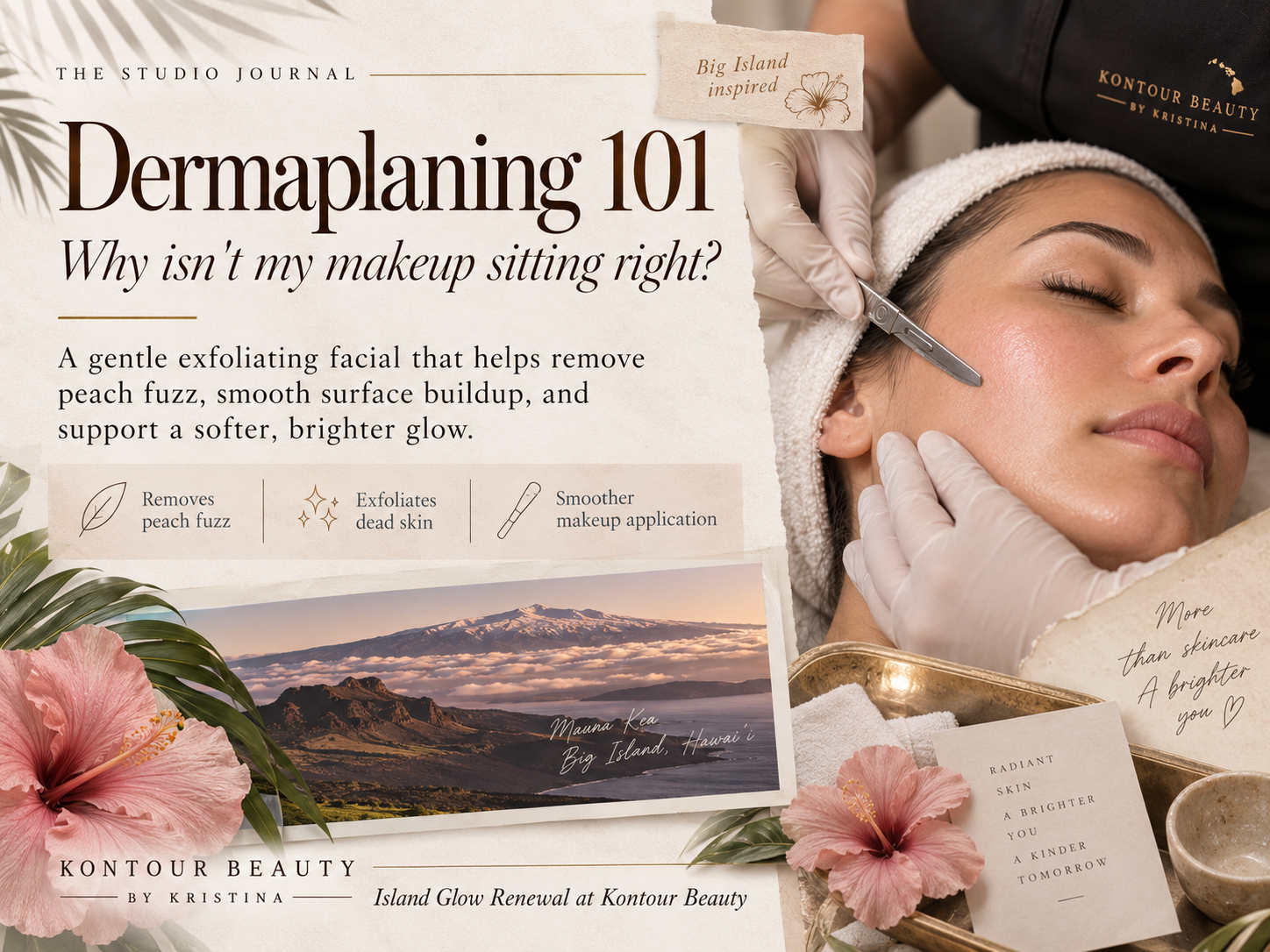
You’ve done your skincare. Applied your foundation. Blended a little more around the areas that never seem to cooperate.
Then you check the mirror in natural light.
Your makeup is catching on certain spots, your cheeks don’t look as smooth as you hoped, and you’re wondering whether you need a different primer, a better foundation, or a whole new routine.
Sound familiar?
Before adding another product to your cart, it may be worth taking a closer look at your skin—not to pick it apart, but to understand what’s happening.
Today, we’re talking about dermaplaning, the service at the heart of my Island Glow Renewal facial at Kontour Beauty.
First, not every rough patch needs more exfoliation
A patchy makeup day does not automatically mean you need dermaplaning.
Dry skin can feel rough, tight, or flaky. Sensitive skin may sting when products are applied. Those concerns deserve a different conversation than simply, “Let’s remove more skin.” Mechanical exfoliation can be too irritating for some dry or sensitive skin types. Cleveland Clinic
That’s why I want to know more than what your skin looks like in a photo.
Does it feel comfortable after cleansing? Have you recently changed products? Are you using a scrub, exfoliating toner, or retinol? Is this a new concern or something you’ve been noticing for a while?
The goal is to choose care that suits your skin—not automatically choose the strongest treatment.
What does dermaplaning actually do?
Dermaplaning is a form of physical exfoliation. A trained professional uses a small, sterile blade to remove dead cells from the skin’s surface along with fine facial hair, commonly called peach fuzz. The result can be a smoother surface and a more radiant appearance. Dermatology of SE Ohio
And let’s clear something up: peach fuzz is normal. Removing it is a cosmetic choice, not a requirement for healthy or beautiful skin. You can keep it, remove it, or decide that this service simply isn’t for you. Cleveland Clinic
For someone who prefers the look and feel of less facial fuzz and a freshly exfoliated surface, dermaplaning may be worth considering.
The benefits—and what they mean in everyday life
Smoother-feeling skin.
Removing surface dead cells can leave the skin feeling softer and less uneven to the touch. This is a surface-level improvement, rather than a promise of completely texture-free skin. Cleveland Clinic
A fresher, brighter appearance.
Exfoliation can help perk up a dull-looking complexion. Think of this as revealing a refreshed surface—not changing your natural skin color or promising to erase pigmentation. Cleveland Clinic
Makeup that may apply more smoothly.
With surface dead cells and fine hair removed, makeup may glide on more evenly. That doesn’t mean every foundation will suddenly work perfectly, but smoother application is one of the practical benefits you may notice. Cleveland Clinic
Whether you enjoy a full face of makeup or prefer a simple, minimal routine, the question is the same: would those benefits be useful to you?
You don’t need a wedding, photo shoot, or special occasion to be curious about your skin.
“But will my facial hair grow back thicker?”
No. Cutting hair at the skin’s surface does not change its thickness, color, or growth rate.
As hair grows back, its freshly cut tip can temporarily feel blunter or more noticeable. That feeling does not mean the hair itself has become thicker. Mayo Clinic
Dermaplaning also isn’t permanent hair removal. The fine hair will grow back, so maintaining the hair-free appearance requires ongoing upkeep rather than a one-time appointment. Cleveland Clinic
When dermaplaning may not be the right choice
Sometimes, the best skincare decision is to wait or choose something gentler.
Active inflamed acne, a cold sore outbreak, an eczema flare, or an irritated rash are reasons to pause and seek appropriate guidance before dermaplaning. Sunburned skin and open wounds should not be exfoliated. Cleveland Clinic
The service is not risk-free, either. Temporary irritation or small nicks can happen, and infection or changes in skin pigmentation are possible complications. Choosing an appropriate treatment and following aftercare matter. Cleveland Clinic
Please also share the skincare products, medications, and recent treatments you’re using. Products such as retinol, prescription retinoids, and benzoyl peroxide can affect how skin tolerates exfoliation. Don’t change prescribed treatment on your own; coordinate any adjustments with your prescriber. American Academy of Dermatology
I would rather help you choose the right service than have you book a treatment just because it’s trending.
And when a concern needs medical evaluation, a dermatologist—not another facial—is the right next step.
Meet your skin ritual: Island Glow Renewal
At Kontour Beauty, Island Glow Renewal is my dermaplaning-focused facial within the Skin Rituals collection.
It brings dermaplaning together with facial care, including a customized mask, rather than making your visit only about removing peach fuzz.
But the conversation matters just as much as the service.
Tell me what you’re hoping to improve. Tell me what you’re already using. Tell me about that one area where your makeup always seems to catch—or that your skin hasn’t felt quite like itself lately.
You don’t need to arrive knowing the names of every ingredient or exactly which treatment to choose.
My goal is for you to understand why we’re choosing a service, what it can realistically offer, and how to care for your skin afterward.
Because a good appointment should leave you with more than a treatment checked off your list. It should leave you feeling heard.
Your aftercare matters, too
After exfoliation, keep your routine gentle and moisturize. This is not the time to assume that adding another scrub or exfoliating treatment will make your results even better; over-exfoliation can leave skin red and irritated. Follow your appointment-specific guidance about when to resume active products. American Academy of Dermatology
And yes, sun protection still matters on an overcast day. For those quick trips into town, school pickups, and afternoons outside, choose a broad-spectrum, water-resistant sunscreen with SPF 30 or higher. When outdoors, reapply approximately every two hours and after swimming or sweating, following the product directions. Shade and protective clothing help, too. American Academy of Dermatology
Have beach plans, an outdoor event, or a special occasion coming up? Bring that up before booking so we can discuss timing and aftercare.
Your skincare should make sense for your real life—not just the hour you spend in the treatment room.
Before you replace your whole makeup routine…
Let’s start with a conversation about your skin.
Maybe dermaplaning is a good fit. Maybe your skin needs a gentler approach first. Either way, you don’t have to figure it out by buying one more product and hoping for the best.
Explore Island Glow Renewal in my Skin Rituals menu, or reach out before booking when you’re unsure which facial to choose.
Your skin doesn’t need to be perfect to deserve thoughtful care.

Not sure if dermaplaning is right for you?
You don’t have to figure it out on your own. Whether you’re curious about peach fuzz, wondering about your makeup application, or unsure which facial to choose, let’s start with a conversation.
Send a quick request, and I’ll follow up by email to discuss your questions and the next steps.
